

30 January 2025, 10:08am
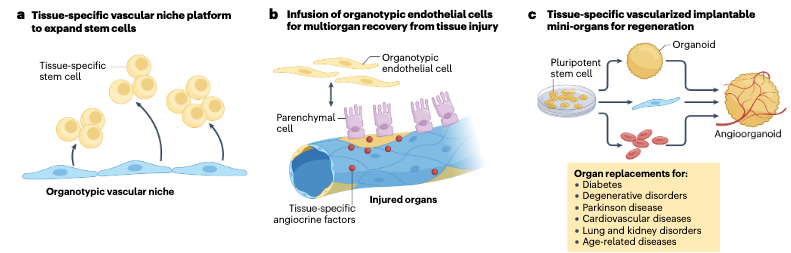
We’re delighted to share the latest news from our Technical Director, Professor David Redmond, whose new publication in Nature reveals how organ-specific blood vessels could transform regenerative medicine. While most of us still picture blood vessels as uniform “tubes,” the reality—captured eloquently in Figure 6 of the paper (below)—is that each tissue’s endothelial cells (ECs) are highly specialized, unlocking groundbreaking therapeutic possibilities.
Blood Vessels That Know Where They Belong
For years, scientists have noticed that certain diseases like diabetes or high blood pressure hit specific organs hardest, from the retina to the kidneys, while sparing others. Professor Redmond’s work helps explain why: each organ’s network of capillaries broadcasts unique, local signals that shape the behaviour and identity of its endothelial cells. By teasing apart these signals, his team is engineering “tissue-specific” ECs capable of homing to damaged organs and supporting specialised regeneration.
Fig. 6 at a Glance: Three Pathways to Healing
- Rejuvenating Stem Cells (Panel A)
In the first strategy, researchers engineer ECs so that they carry the precise molecular cues needed to expand authentic stem cells outside the body. This is especially critical for hematopoietic stem and progenitor cells—the source of new blood and immune cells—and could also enable pro-regenerative pathways in tissues like the liver. Imagine having access to limitless, fully functional stem cells for patients with sickle cell disease or cirrhosis, without depending on donor matches. - Targeting Damaged Organs (Panel B)
The second approach involves infusing these engineered, tissue-specific ECs directly into the bloodstream. Because these cells express the right suite of surface markers, they “know” which organ to migrate to and repair—effectively homing in on areas of vascular damage caused by chemotherapy or radiation. Think of them like microscopic paramedics, rushing to exactly where they’re needed and patching things up at the cellular level. - Building Vascularized Mini-Organs (Panel C)
Lastly, tissue-specific ECs can be embedded into organoids—tiny, lab-grown models of organs—to create vascularized mini-organs. These living, structured tissues can potentially be transplanted to replace damaged organ sections, with the bonus of built-in blood vessel networks that enhance survival and function. From insulin-producing pancreatic organoids for diabetics to liver organoids that can regenerate cirrhotic tissue, the clinical promise is enormous.
The Potential for Game-Changing Therapies
These discoveries have far-reaching implications:
- Stem Cell Expansion: Boosting the supply of robust hematopoietic stem cells could revolutionize treatments for blood disorders.
- Organ Repair Without Fibrosis: If we can harness liver-specific ECs to “nudge” damaged livers toward healing rather than scarring, patients with chronic liver disease might avoid transplants.
- Custom-Tailored Transplants: Vascularized mini-organs offer a future where organ repair is personalized, potentially sidestepping the complexities of donor shortages and immune rejection.
Why Data Analytics Plays a Key Role
At Vuzo, we’re especially intrigued by how big data and advanced imaging power this new field. By parsing vast datasets—from gene expression profiles to 3D imaging of microvessels—scientists can pinpoint the precise molecular signals that give each tissue’s ECs their identity. This marriage of computational analysis and biology opens the door to designing hyper-specific, next-generation therapies.
Looking Ahead
Professor Redmond’s research into vascular “zoning” exemplifies how interdisciplinary science can address some of the most formidable challenges in medicine. From rejuvenating blood stem cells to building mini-organs, these innovations promise to reshape patient care and usher in a new era of precision regenerative medicine.